Phase One Report

Accelerating data-driven research at Yale

To help policymakers get faster answers to urgent policy questions, we work with partners throughout the university community to streamline complex research processes.

Rigorous economics research is complex to manage and produce, and faculty must overcome a range of administrative and operational hurdles before the core research process even begins.

The Tobin Center works with individual faculty researchers and other members of the Yale community to provide research support, fill operational gaps, and streamline processes so researchers can answer big questions faster.

Tobin Center Pre-Doctoral Fellows Program

We run one of the largest pre-doctoral research training programs in the United States

The Tobin Center’s Pre-doctoral Fellows Program trains the next generation of social science leaders.

Since its inception, the Tobin Center Pre-doctoral Research Fellows Program has helped prepare more than 254 young researchers for doctoral programs and other roles at leading research institutions.

A vibrant and diverse community that supports dozens of scholars from around the world annually, the program provides young researchers with the opportunity to work for one to two years as full-time research trainees supervised by Yale faculty.

Fellows also have the opportunity to engage in additional education and professional development activities, including taking for credit or auditing one course per semester, participating in a weekly professional development seminar, and attending department research seminars.

Learn More

Pre-Doctoral Fellows in the News

Clara Chambers

For Clara Chambers, the opportunity to produce policy-relevant research came in her first year as a Tobin Center Pre-doctoral Research Fellow.

Clara’s work on the decline in marriage rates among women without college degrees was featured in Axios, and she had the opportunity to write about the research for the American Institute for Boys and Men and present it at a conference hosted by the National Bureau for Economic Research. The process of producing the research helped Clara see first-hand how timely, policy-relevant research can drive conversation and influence decisionmakers.

“Tobin encouraged me to pursue questions that excited me beyond my day-to-day work, and my faculty advisors gave me the guidance I needed to turn those ideas into real research. Their support, from early drafts through public communication and the publication process, made the project possible.”

Read More

From Pre-Doctoral Fellow to Yale Phd

Jackson Howell

Working under Professors Cormac O’Dea and John Geanakoplos to study Social Security and the 401(k) system, Jackson Howell developed news skills that proved invaluable as he began doctoral studies at Yale.

Through the mentorship he received in the Tobin Center Pre-doctoral Fellows Program, Howell—who is now in his second year of the economics Ph.D. Program at Yale—says he learned to come up with interesting and precise questions, how to go about answering them, and how to communicate those answers in a clear and concise way.

“These sorts of things are often not teachable in a classroom, and the Tobin Center program is a unique opportunity to build a relationship with an experienced researcher–someone directly invested in the success of your work–whom you can learn these skills from.”

“The personal and professional relationships I made in the program were the most important part of my experience,” Howell said. “Not only did I receive productive advice from my faculty advisors, but exposure to graduate students and other pre-doctoral fellows greatly helped me develop my knowledge and skills as an economist. The collegiality among the fellows and close relationships between the fellows and their advisors is a huge strength of the Tobin program.”

Photo Credit: Chuck Croi

The Tobin Center predoctoral fellows have gone on to earn admission to top Ph.D. programs in economics and related fields.

The colleges and universities below represent just some of the institutions where our alumni have continued their academic training.

The Data-Intensive Social Science Center

We helped establish a best-in-class research support hub at Yale

The Data-Intensive Social Science Center is positioning Yale at the forefront of the data revolution

Modern economics research increasingly depends on complex infrastructure to unlock breakthrough discoveries.

The Data-Intensive Social Science Center (DISSC), launched in 2022, positions Yale at the forefront of this data revolution by serving as a hub of support for economics researchers from across the university.

The Tobin Center worked with partners across the university to establish DISSC. Today, DISSC supports Yale’s social science community throughout the research lifecycle by managing data procurement and licensing fees, supporting faculty on legal compliance and data processing, and providing expert guidance on everything from conducting surveys to using AI and machine learning tools—all while strengthening internal processes and building community through its targeted programming.

From Research to Impact

Transforming research into tools policymakers can use

Economics research at Yale continually uncovers new findings that deepen our understanding of the world around us. But too often that research is locked away in academic journals or shrouded in jargon that makes it difficult to understand.

The Tobin Center is committed to working with Yale faculty to turn their research into new tools and products that policymakers, journalists, and others can use with ease–so more people can inform their decisions with high-quality information.

One example of this work is a new tool from the Tobin Center’s Health Care Affordability Lab that can help state Attorneys General and other policymakers understand the role that hospital consolidation is playing in the health care affordability crisis.

Our research revealed that hospital consolidation leads to higher prices, job losses, and early death.

Research from Professor Zack Cooper, director of the Health Care Affordability Lab at Yale, revealed that hospital consolidation is a major and underappreciated source of rising health care prices in communities across the country.

When hospital mergers raise prices, health spending and insurance premiums increase. In turn, companies outside the health sector face additional costs that make it harder to retain workers, leading to increases in unemployment locally. The jobs lost when hospital prices rise are concentrated among workers earning less than $100,000 a year. The research relies on a new methodology that ultimately measures the number of people expected to die prematurely from conditions related to job losses that result from hospital consolidation.

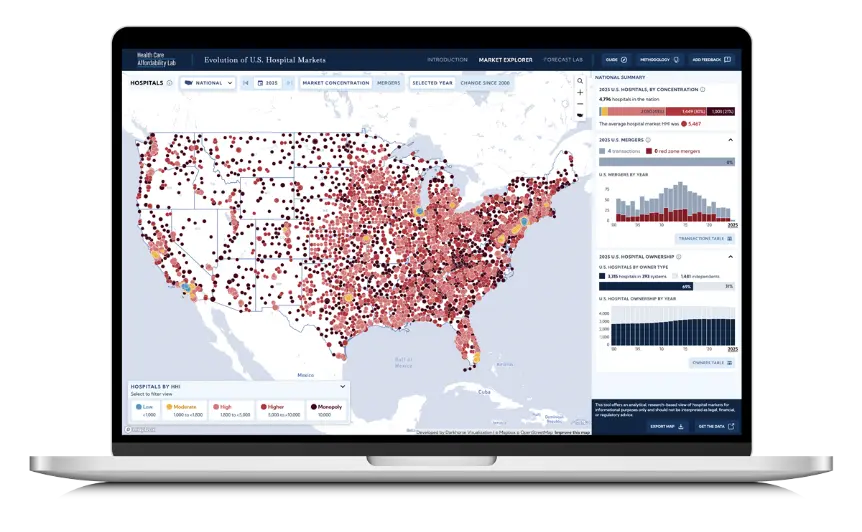
We built a tool that shows the impact of past and proposed hospital mergers in every community since 2000.

Of course, not all hospital mergers or acquisitions are problematic, and some are likely to have more severe consequences than others. To help policymakers and others understand the impact of past or proposed hospital mergers, closures, or ownership changes in their own communities, we synthesized data from public and private sources to create a new tool that tracks the impact of hospital concentration across the U.S. over the past twenty-five years.

What’s more, the tool’s forecast function allows users to simulate potential mergers and view their estimated impact on the competitiveness of a hospital market.

See the effects of rising hospital concentration in every community across the U.S.

Screenshot of hospital markets explorer tool

Visit the Hospital Markets Explorer

We’re sharing the tool with federal and state policymakers to inform antitrust enforcement.

Federal and state policymakers could do more to prevent hospital consolidation, but they need easy access to reliable information in order to make informed decisions.

In the time since the tool’s launch, state and federal antitrust enforcement agencies have used it to determine whether they should spend their limited resources intervening against a proposed merger.

Learn more